

Closing Entries Definition, Examples, and Recording

closing revenue accounts

The second part is the date of record that determines who receives the dividends, and the third part is the date of payment, which is the date that payments are made. Printing Plus has $100 of dividends with a debit balance on the adjusted trial balance. The closing entry will credit Dividends and debit Retained Earnings. Regularly closing your books will prevent unwanted changes from occurring to your accounting data after you generate important financial reports for your accountant or tax professional. Some accounting software automatically closes your income and expense accounts at year-end before adding your net profit (or loss) to your retained earnings account. Accounting software may create an automatic closing date as well as a password so transactions from before the closing date can’t be changed.

Why You Can Trust Finance Strategists

Both closing entries are acceptable and both result in the same outcome. All temporary accounts eventually get closed to retained earnings and are presented on the balance sheet. Closing all temporary accounts to the retained earnings account is faster than using the income summary account method because it saves a step. There is no need to close temporary accounts to another temporary account (income summary account) in order to then close that again. Permanent accounts track activities that extend beyond the current accounting period.

Credits & Deductions

After the closing journal entry, the balance on the drawings account is zero, and the capital account has been reduced by 1,300. These temporary or “nominal” accounts are zeroed out and reset when closing entries are added to an accounting system so they don’t affect the next accounting period. Sum your general ledger accounts again to take into account the adjusted entries from the last step, and then add them all together to make a new trial balance, making sure your debits and credits are again equal. Adjusting entries record items that aren’t noted in daily transactions. These items include accumulation (known as “accrual” in accounting) of real estate taxes or depreciation accrual, which need to be recorded to close the books. Post the account totals from your cash payments and your sales and cash receipts journal to the appropriate general ledger account to close the books.

Step 2: Clear expenses to the income summary account

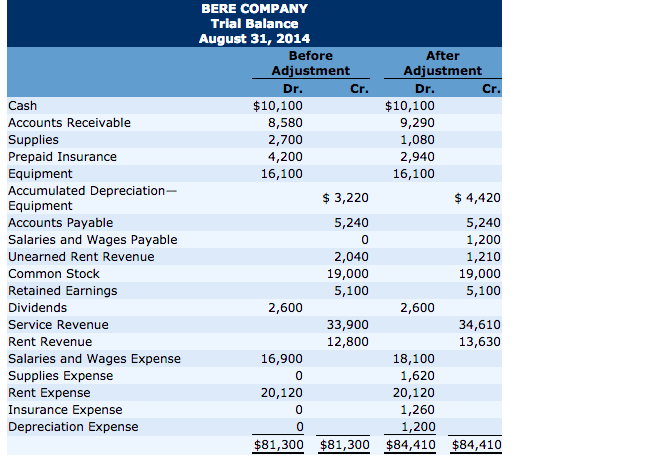
Remember the income statement is like a moving picture of a business, reporting revenues and expenses for a period of time (usually a year). We want income statements to start every year from zero, but for accounts like equipment, debt, and cash accounts—reported on the balance sheet—we want to keep a running balance from the beginning of the business. Now that all the temporary accounts are closed, the income summary account should have a balance equal to the net income shown on Paul’s income statement. Now Paul must close the income summary account to retained earnings in the next step of the closing entries. Temporary accounts, also known as nominal accounts, are accounts that track financial transactions and activities over a specific accounting period. These accounts are “temporary” because they start each accounting period with a zero balance and are used to accumulate data for that period only.

Temporary and Permanent Accounts

  • Both closing and opening entries record transactions, but there is a slight variation in their purpose.
  • Once we have made the adjusting entries for the entire accounting year, we have obtained the adjusted trial balance, which reflects an accurate and fair view of the bakery’s financial position.
  • The closing entry entails debiting income summary and crediting retained earnings when a company’s revenues are greater than its expenses.
  • The purpose of closing entries is to transfer the balances from temporary accounts (revenues, expenses, dividends, and withdrawals) to a permanent account (retained earnings or owner’s equity).

The Retained Earnings account balance is currently a credit of $4,665. In this chapter, we complete the final steps (steps 8 and 9) of the accounting cycle, the closing process. You will notice that we do not cover step 10, reversing entries. This is an optional step in the accounting cycle that you will learn about in future courses. Steps 1 through 4 were covered in Analyzing and Recording Transactions and Steps 5 through 7 were covered in The Adjustment Process.

Which accounts are closed at the end of an accounting period?

The post-closing T-accounts will be transferred to the post-closing trial balance, which is step 9 in the accounting cycle. You might be asking yourself, “is the reserve accounting wikipedia Income Summary account even necessary? ” Could we just close out revenues and expenses directly into retained earnings and not have this extra temporary account?

In contrast, temporary accounts capture transactions and activities for a specific period and require resetting to zero with closing entries. Closing entries are a fundamental part of accounting, essential for resetting temporary accounts and ensuring accurate financial records for the next period. This process highlights a company’s financial performance and position.
closing revenue accounts

Since the income summary account is only a transitional account, it is also acceptable to close directly to the retained earnings account and bypass the income summary account entirely. These finalized reports show a business’s financial position over a certain accounting period—whether a month or an entire year. Automation transforms the process of closing entries in accounting, making it more efficient and accurate. By leveraging automated systems, businesses can ensure that all tasks related to closing entries are handled seamlessly, reducing manual effort and minimizing errors.

Shaun Conrad is a Certified Public Accountant and CPA exam expert with a passion for teaching. After almost a decade of experience in public accounting, he created MyAccountingCourse.com to help people learn accounting & finance, pass the CPA exam, and start their career. Net income is the portion of gross income that’s left over after all expenses have been met. The term “net” relates to what’s left of a balance after deductions have been made from it.

Note that by doing this, it is already deducted from Retained Earnings (a capital account), hence will not require a closing entry. Temporary accounts can either be closed directly to the retained earnings account or to an intermediate account called the income summary account. The income summary account is then closed to the retained earnings account. No, permanent accounts carry their balances forward to the next accounting period. A net loss would decrease retained earnings so we would do the opposite in this journal entry by debiting Retained Earnings and crediting Income Summary.

Closing Entries in Accounting: Everything You Need to Know +How to Post Them

closing revenue accounts

At the end of the accounting period, the balances in these accounts are transferred to permanent accounts, resetting the temporary accounts to zero for the next period. The process of closing entries in accounting ensures the temporary accounts have a balance of zero at the end of the period. The funds must be transferred into another account, the income summary account, to bring each account balance down to zero.

Time Value of Money

This means that it is not an asset, liability, stockholders’ equity, revenue, or expense account. The account has a zero balance throughout the entire accounting period until the closing entries are prepared. Therefore, it will not appear on any trial balances, including the adjusted trial balance, and will not appear on any of the financial statements. To further clarify this concept, balances are closed to assure all revenues and expenses are recorded in the proper period and then start over the following period. The revenue and expense accounts should start at zero each period, because we are measuring how much revenue is earned and expenses incurred during the period.

Step 3: Close Income Summary to the appropriate capital account

In other words, the temporary accounts are closed or reset at the end of the year. Also known as real or balance sheet accounts, these are general ledger entries that do not close at the end of an accounting period but are instead carried forward to subsequent periods . Real accounts, also known as permanent accounts, are quite different compared to their temporary equivalents. They persist from one accounting period to the next and maintain their balances over time unlike temporary accounts which are closed at the end of the period.

Company

They’re housed on the balance sheet, a section of financial statements that gives investors an indication of a company’s value including its assets and liabilities. The purpose of the closing entry is to reset temporary account balances to zero on the general ledger, the record-keeping system for a company’s financial data. Each accounting period’s data must be contained within the designated time frame in order to accurately depict the financial standings of the company. Journal entries are an essential part of the accounting process for any business.

  • The net income (NI) is moved into retained earnings on the balance sheet as part of the closing entry process.
  • When you close the books monthly, that means you make journal entries to ensure all transactions for the month have been captured.
  • They offer an overview of a business’s financial position at the end of the applicable accounting period, whether that’s the previous month or year.
  • No, permanent accounts carry their balances forward to the next accounting period.
  • Before creating your final report, generate a trial balance, and if things are not adding up, check your work and enter adjusting entries until you are ready to create the final financial statement.
  • State whether each account is a permanent or temporary account.

The balance of the Income Summary account is transferred to the Retained Earnings account. The number of closing activities may be quite substantially longer than the list shown here, depending upon the complexity of a company’s operations and the number of subsidiaries whose results must be consolidated. The articles and research support materials available on this site are educational and are not intended to be investment or tax advice. All such information is provided solely for convenience purposes only and all users thereof should be guided accordingly.

closing revenue accounts

Drawings Accounts and Closing Journals

Businesses often use professional bookkeeping services to ensure they are on track financially, are tax-season ready, and are able to continue to grow and thrive. Get started here if you want to speak to a professional about your business cash flow. Most small companies close their books monthly, though some only do so at year’s end. That means you need to choose what entries you want to include. For example, you could choose all entries in 2025, or it could be for the month of January 2025 only.

Reporting cycles are an essential part of the accounting process. The cyclical reporting of accounting periods can span monthly, quarterly, and annual time frames. However, when it comes to opening and closing accounts, this typically happens on a yearly or monthly basis, depending on the type and size of the company. Why was income summary not used in the dividends closing entry?

Just like in step 1, we will use Income Summary as the offset account but this time we will debit income summary. The total debit to income summary should match total expenses from the income statement. The second entry requires expense accounts close to the Income Summary account. To get a zero balance in an expense account, the entry will show a credit to expenses and a debit to Income Summary. Printing Plus has $100 of supplies expense, $75 of depreciation expense–equipment, $5,100 of salaries expense, and $300 of utility expense, each with a debit balance on the adjusted trial balance.

Let’s explore each entry in more detail using Printing Plus’s information from Analyzing and Recording Transactions and The Adjustment Process as our example. The Printing Plus adjusted trial balance for January 31, 2019, is presented in Figure 5.4. State whether each account is a permanent or temporary account. It is the end of the year, December 31, 2018, and you are reviewing your financials for the entire year. You see that you earned $120,000 this year in revenue and had expenses for rent, electricity, cable, internet, gas, and food that totaled $70,000. An accounting year-end which is not the calendar year end is sometimes referred to as a fiscal year end.

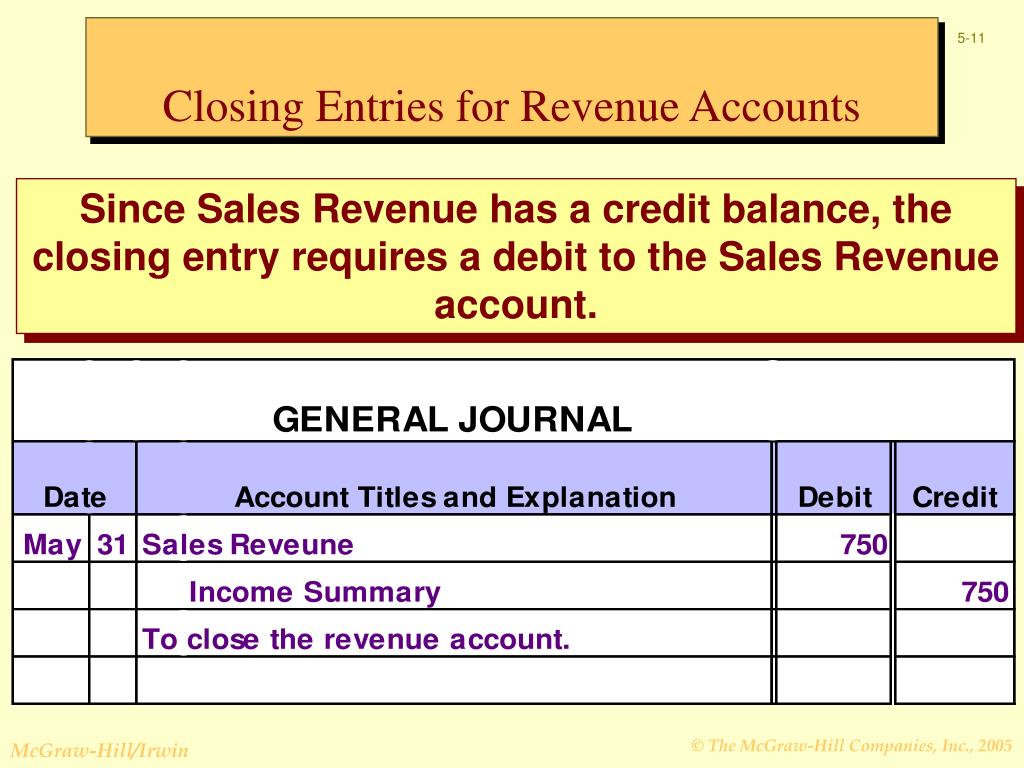
This is closed by doing the opposite – debit the capital account (decreasing the capital balance) and credit Income Summary. To close expenses, we simply credit the expense accounts and debit Income Summary. To close that, we debit Service Revenue for the full amount and credit Income Summary for the same. Notice how only the balance in retained earnings has changed and it now matches what was reported as ending retained earnings in the statement of retained earnings and the balance sheet.

Dividends are always transferred directly to retained earnings. The purpose of the closing process for each period is to avoid incorrectly recording income or expenses in previous periods. Before creating your final report, generate a trial list of tangible and intangible assets balance, and if things are not adding up, check your work and enter adjusting entries until you are ready to create the final financial statement. To close revenue accounts, you first transfer their balances to the income summary account.